This page is from a class I ran at the Guilded Symposium in Bordescros in Aug 2024.
I haven’t seen a lot on edible flowers in medieval cookery books. There’s a few recipes where they are a specialist ingredient, which I’ll come to. But you don’t really read about flowers in salads as we now like to do – Forme of Cury (14th century) mentions borage as an ingredient, which surely would be the pretty flowers rather than the leaves, but that’s not suggested by the context. Another recipe from the same source implies cooking with violet leaves rather than the flowers.
Garnishes
Anybody who has watched “Great British Bakeoff” will have seen how fabulous the cakes look when garnished with flowers. It’s a really easy way of making your feast spectacular, if you have access to flowers grown without pesticides.
My best-practice for feasts (see FoodForTheFeast.com) includes having a person to add garnishes, as well as serving spoons and table-markers for efficient service. Flowers are not the only thing I use: chopped chives (I like them long) or parsley or golden marjoram are additional garden produce for this purpose.
For flowers, fresh is easy and cheap, but you are at the mercy of the seasons and bugs. Fresh flowers also need to be cut not long before serving, which is yet another thing to do on the day.
Crystallising
For that reason, it is worth considering crystallising some flowers in the preceding week. The effect is a little softer, so choose your dishes or they will just blur out.
The earliest reference I’ve seen is in the Treasurie of Commodious Conceits (1573) which just talks about putting violets into sugar in March, to preserve them.
The recipe you see these days is that you dip the petals or flowers in eggwhite and dust them with caster sugar. (More delicate flowers or petals need finer sugar; grind your caster sugar a little smaller. I expect you could use icing sugar for really tiny stuff, but I haven’t done it myself.) A closet for ladies and gentlewomen (1608) says to start first with gum arabic dissolved in rosewater, which will make them last much longer.
English housewife (1615) says to dip them in a cold sugar syrup, then again in progressively stronger sugar syrups. Elinor Fettiplaces’s Receipt Book (1604, at least in parts) has just one syrup, with specific instructions on how candied it should be.
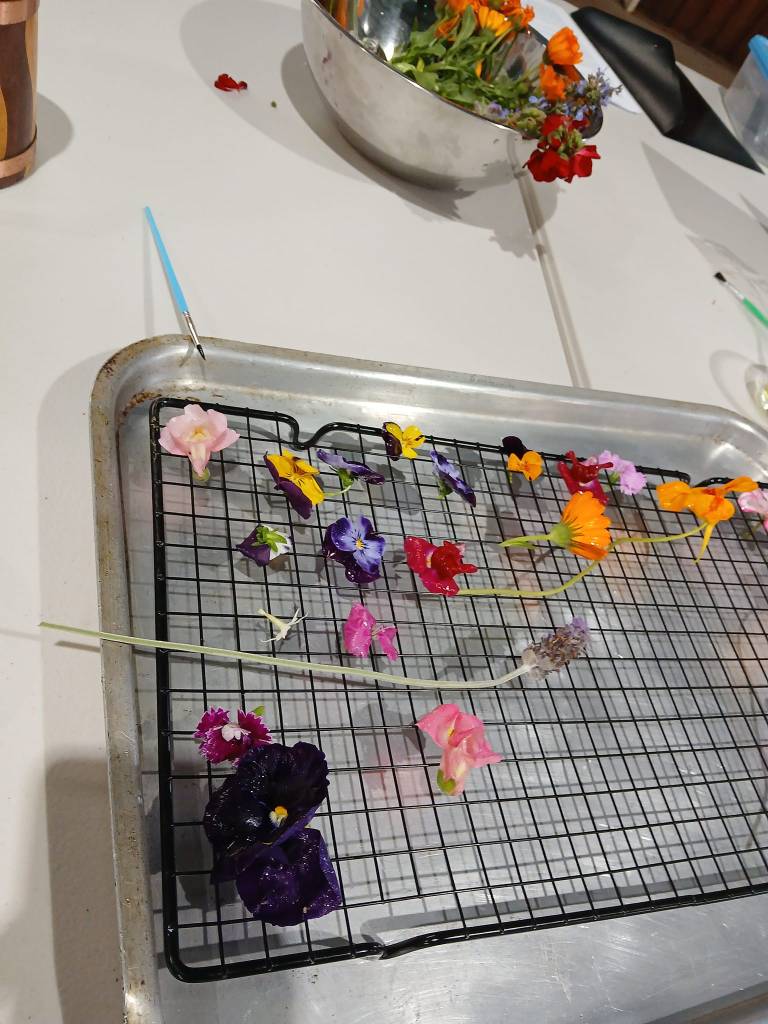
Garnish flowers
Good flowers for garnishes include:
- Violets and pansies. “Johnny Jump Ups” are a good variety for lazy gardeners as they are a really pretty, a handy small size and self-seed all over your garden, as do violets to some extent. You can get white violets!
- Borage flowers are a lovely blue that crystallises well (also available in white). Borage self-seeds so it’s easy to have in bulk, and the flowers are pretty solid and can take some handling.
- Cornflowers are really showy. Tear petals off for a mild clove flavour. They are quite big to crystallise but you can do it. Classically blue, but now available in many other shades including some great pinks.
- Chive flowers are pulled off to make a lovely purple-blue scattering, with an oniony aftertaste. Mistress Alys Dietsch does them on stuffed eggs and they look amazing. If you grow chives, you have these for much of the year.
- Nasturtiums are vivid, originally orange and now in several colours. The leaves too are delicious in a salad. Strictly speaking, these are New World produce, but there’s plenty of medieval cottage garden flowers we can’t really access so I reckon it’s fair to use them.
- Marigolds (the calendula variety) are generally orange or yellow, and lend themselves to being chopped as a dressing on top of dishes. They were used as a saffron substitute for colouring food. It’s easy to grow a lot of calendula. And you can mix several colours to great effect! Leave out the white centre bit, it’s bitter.
- Roses are great, but a bit delicate. Really only red or white flowers are characteristic of our period, but I won’t pick you on it. Roses are particularly in danger of having pesticides on them, so be sure of your source.
- Dandelions are cute and in theory you can crystallise them, but I haven’t done it. The french word for them is pissenlit, piss-in-bed, so watch for unexpected side-effects!
As an ingredient
Flowers are ingredients in a few notable recipes. Alas, they often have very short harvest periods, affected by seasonal variations, so you just can’t count on them for a feast of any size. Certain dishes can be frozen successfully, so that may be an option.
Some good options are:
- Mayflowers (hawthorn). It’s a tree weed in our part of the world, with lovely white flowers. You can make a pudding called spynee, in season. Never blooming when I have a feast on.
- Elderflowers. Forme of Cury has a very early cheesecake, called sambocade. Or you can make fritters of the blossoms. Again, available for just a short period, and you need enough for a whole feast. Elderflower trees are easy to grow and produce lots of blooms.
- Roses. There’s a dish called rosee, made with pinenuts and dates, which specifies white roses for some reason. Another variation includes chicken meat!
- Flowers of zucchini (especially) and pumpkin can be stuffed and baked or used for fritters. Don’t worry too much about losing the fruit, the vines will just put out more flowers. BTW if you grow pumpkins you have lots of leaves, which can be cooked too!
- Artichokes are a flower, and there’s various medieval and modern recipes available. We eat our artichokes once or twice a year. It’s hard for a home garden to produce enough for a feast.
As a syrup or preserve
It’s possible to make a syrup out of several flowers, like roses, violets and elderflowers. I query whether it’s worth the work, when you can buy the syrups. Violet syrup is really pretty, but (like coriander) a portion of people dislike the taste.
You can pickle things like artichoke hearts, but really it’s a lot of work when you can buy them cheaply. We have done these things, just to say we have!
Sugar pastes
Delights for Ladies (1609) gives a recipe for grinding violets with sugar and rosewater to make a modelling paste with the colour and smell of the flower. It says you can do it with any flower. I haven’t tried it!
 Food for the Feast